AI

Overhear : Securing AI Agents

A good framework on how to think about security when deploying AI agents.

Treat AI agents as insider threats

David Cox mentioned this during a recent conversation with Grant Harvey and Corey Noles on the Neuron podcast. Very simple, but very elegant. Once you frame agents this way, familiar tools – least privilege, role-based access, audit logs – suddenly apply cleanly. The attack surface shrinks not because agents are safer, but because their blast radius is smaller.

AI and the value of taste

Anyone can now generate content (text, audio, images, video) with a single prompt. The cost of creation is collapsing to near zero. We live in amazing times.

It also produces what people have started calling slop: an overwhelming volume of content, much of it interchangeable. When supply becomes infinite, attention becomes scarce. Two thoughts follow from this.

First, the era of personalized content is finally here.
When generation is cheap, we don’t just filter existing content, we generate it. Instead of an algorithm deciding what you might like from a global pool, your feed can be created specifically for you, reflecting your interests, context, and intent. This is a meaningful shift: from recommendation to creation.

Second, as the cost of generation goes to zero, the value of taste goes to infinity.
When anyone can make something, what matters is knowing what should be made. Taste becomes the constraint. Just as there is one Picasso among thousands of painters, there will be people who can consistently direct AI toward work that resonates. They may not produce the content themselves, but they shape it—through judgment, curation, and intent.

In a world flooded with output, taste is the differentiator.

Overheard : On constant increase in expectations

Sam Altman’s June 10, 2025 post on achieving singularity captured something I’ve been thinking about lately. There’s a particular passage that perfectly describes how we’re constantly ratcheting up our expectations:

Already we live with incredible digital intelligence, and after some initial shock, most of us are pretty used to it. Very quickly we go from being amazed that AI can generate a beautifully-written paragraph to wondering when it can generate a beautifully-written novel; or from being amazed that it can make live-saving medical diagnoses to wondering when it can develop the cures; or from being amazed it can create a small computer program to wondering when it can create an entire new company. This is how the singularity goes: wonders become routine, and then table stakes.

This hits at something fundamental about human psychology. We have this remarkable ability to normalize the extraordinary, almost immediately.

I see this everywhere now. My kids casually ask AI to help with homework in ways that would have seemed like science fiction just three years ago. We’ve gone from “can AI write coherent sentences?” to “why can’t it write a perfect screenplay?” in what feels like months.

The progression Altman describes—paragraph to novel, diagnosis to cure, program to company—isn’t just about AI capabilities scaling up. It’s about how our mental models adjust. Each breakthrough becomes the new baseline, not the ceiling.

What struck me most is his phrase: “wonders become routine, and then table stakes.” That’s exactly it. The wonder doesn’t disappear because the technology got worse—it disappears because we got used to it. And then we need something even more impressive to feel that same sense of possibility.

Agency for AI Agents

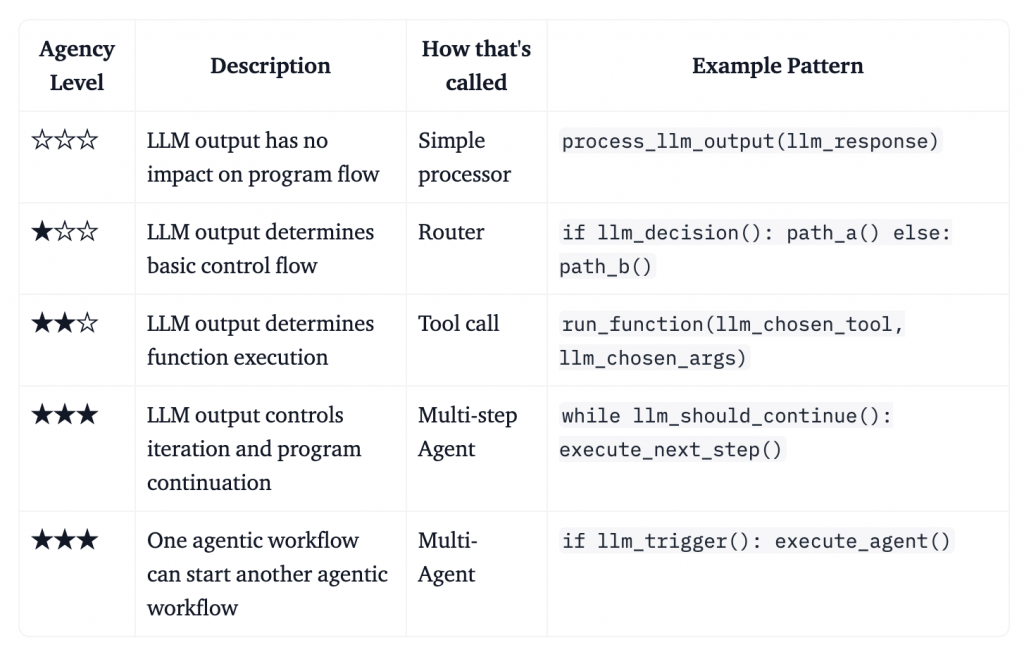
Huggingface just released their agentic library to interact with LLMs. I liked the way they define agents.

AI Agents are programs where LLM outputs control the workflow.

And the way they defined the spectrum of agency for the agents

30 day challenge : create software with AI

I like to do 30 day challenges to explore new areas, or to form habits. Some of my previous ones were

I am starting a new challenge today, to create software by leveraging AI. The recent boom in AI and GenAI specifically has made it very easy and quick to bring your ideas to fruition. It is time to start coding and developing software for ideas that have been swirling in my head for sometime.

I will be publishing them at https://kudithipudi.org/lab . I will expand and write up about some ideas and the experience in bringing them to life.

Inspired by https://tools.simonwillison.net/.